Small Business Bookkeeping Spreadsheet
- ⬇ Files delivered instantly after purchase
- ∞ Lifetime access — download anytime
- ✎ You type in tinted cells; every formula is built & protected
- ♲ Support: message us any time, we answer personally
About this system
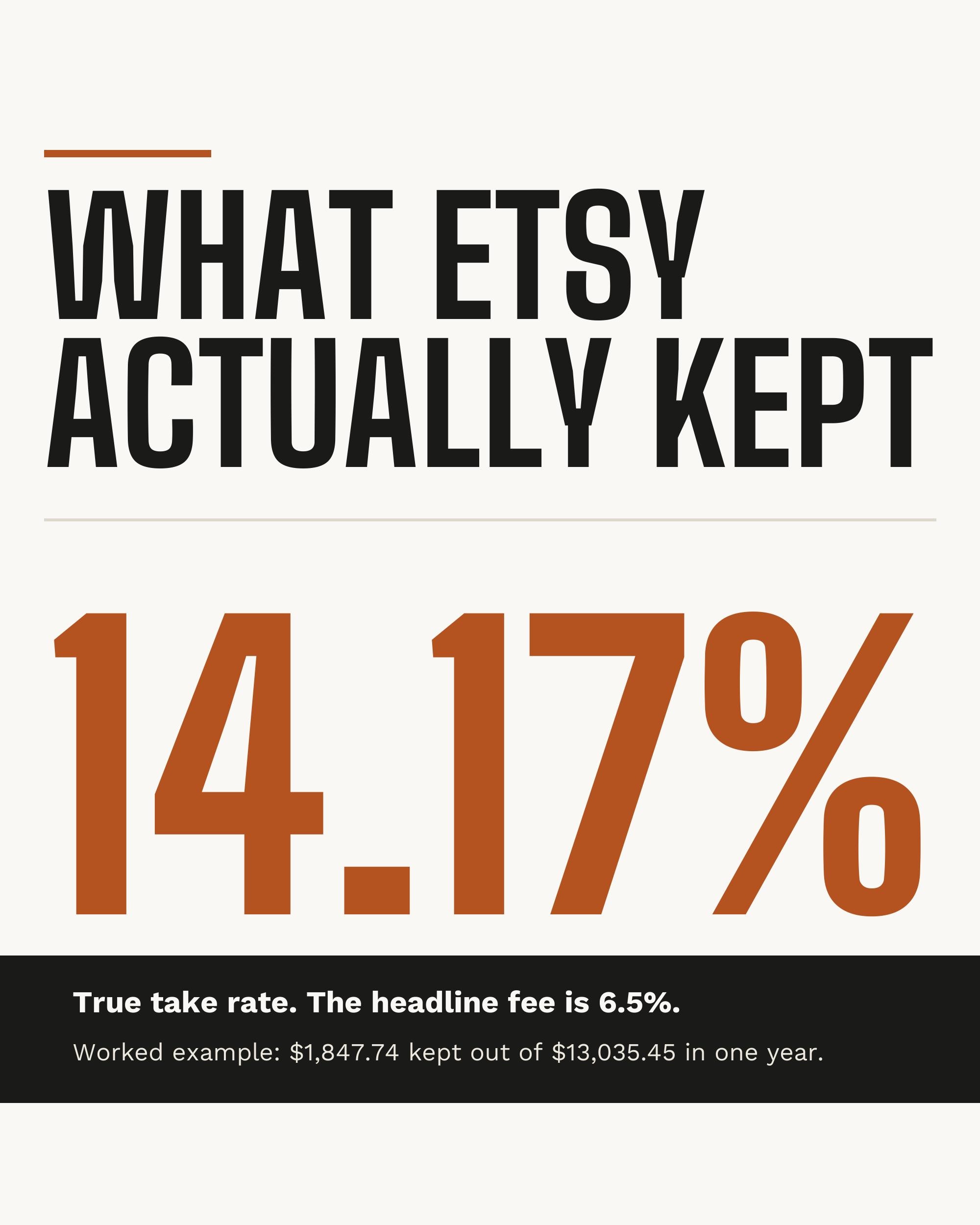
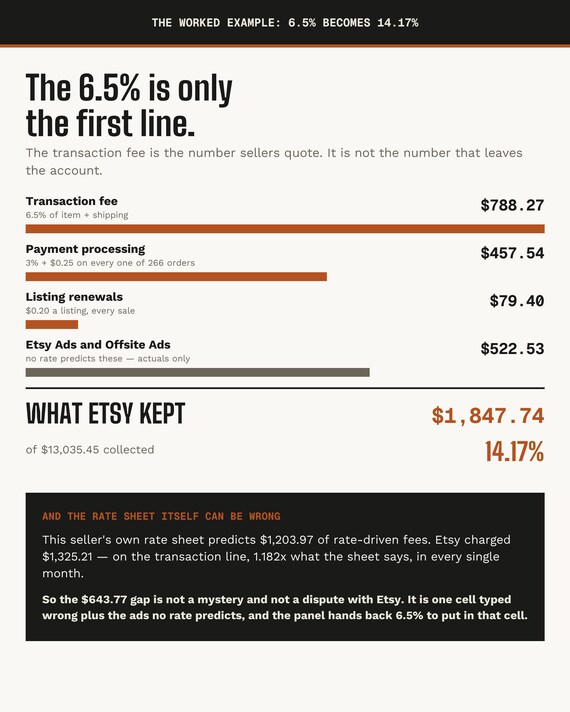
You think Etsy takes 6.5%.
Open your own monthly statement and add it up. There is the 6.5% transaction fee — but it is charged on your shipping too. There is a payment processing fee with a flat amount attached to every order, not every item. There are listing fees that renewed quietly each time something sold. There is advertising. In the worked example that comes with this workbook, a shop with $13,035.45 in sales paid $1,847.74 to Etsy. That is 14.17%, not 6.5%.
This workbook computes that number from your own file, in the first minute, before you have typed anything.
What It Does That A Template Does Not
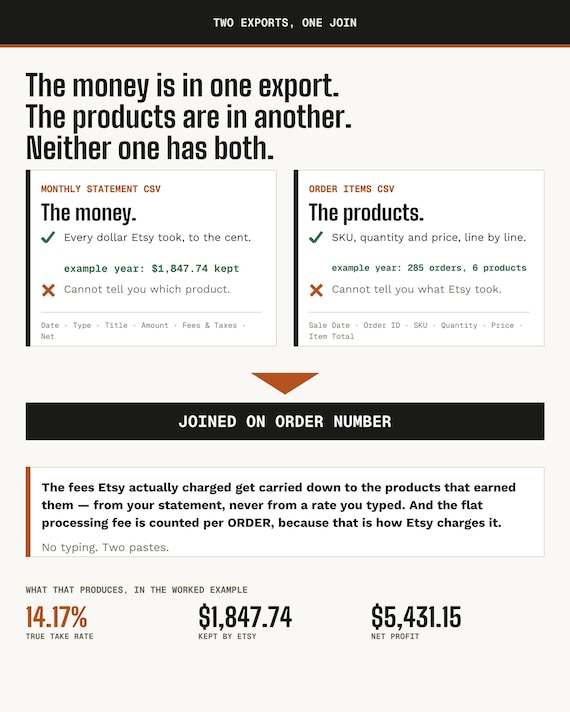
Etsy gives you two exports and they do not talk to each other.
Your monthly statement holds the real money — every fee, exactly as charged — but it does not know what you sold. Your order items file knows the product, the quantity and the price, but not what Etsy took. One has the money, the other has the products, and neither has both.
This workbook joins them. Paste both, and every fee Etsy actually charged gets carried down to the product that caused it. Not an estimate, not a percentage you typed in — the fee from your statement, landing on a real item.
That is where per-product profit comes from, and it is why this cannot be done with a rate you guess at.
The Example File Has Four Things Wrong With It On Purpose
A demonstration where everything passes proves nothing.
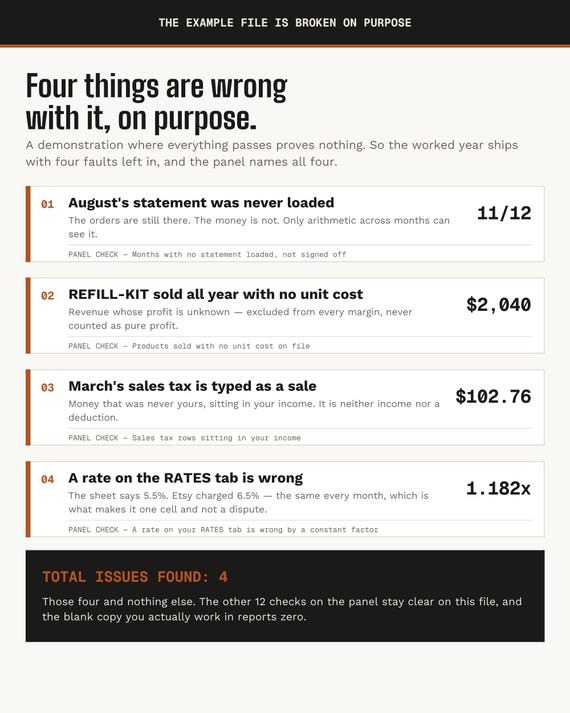
So the filled-in copy holds a complete fictional year with four faults left in deliberately, and the audit panel finds all four and names them:
A month whose statement was never loaded — the orders are there, the money is not.
A product sold all year with no unit cost on file. Its $2,040 of revenue is pulled out of the margin figures and reported separately as profit unknown. It is never counted as pure profit, which is the quiet way a spreadsheet flatters you.
A sales tax amount sitting in income. Etsy collects and remits that tax as the marketplace facilitator; it is a pass-through and it is neither your income nor your deduction. It is quarantined out of every total.
And a rate on the settings tab that is simply wrong. Rather than accusing Etsy on hundreds of individual orders, the workbook notices that the gap is the same every single month, reports "Etsy charged 1.182 times what your sheet predicts," and hands back the rate that actually reproduces the charges.
That last one is the difference between a checker and a nuisance.
What Else Is In It
Eleven tabs. A money board that answers the daily question on one screen. An order ledger that computes the fee each order should have carried. Profit per product after real fees, with a price floor. A profit and loss laid out in Schedule C language, ready for whoever prepares your return. An audit panel of sixteen live checks, each naming a specific thing to fix. A monthly checklist, because the reason people abandon these in March is re-typing, and there is none here.
Every check can be signed off with a typed reason if it does not apply to you. A file that nags at you forever is a file you close.
About The Rates, Straight
Etsy's fees change, and they differ by country. So no rate is buried in a formula. They live on one tab, each with the date it took effect and the official Etsy page it came from, and you maintain them. A workbook with rates welded into its formulas would quietly go wrong within months and never mention it.
This version is built for sellers paid in US dollars.
WILL IT OPEN?
Excel 2016 and newer, Microsoft 365, Excel for Mac, and Google Sheets. No macros, no add-ons, nothing to install, nothing to connect. It reads files you download from Etsy yourself, so there is no login to expire and no permission to grant.
One warning worth more than the rest: the Etsy app cannot download files at all. It will show you the order and even a download button, and nothing usable will happen. Use a browser — the included card walks you through it on iPhone, Android and desktop, and swiftbudgetco.com/open has the same thing. Still stuck, message the shop with your order number. A real person answers.
Honest Limits
It is not tax advice and it does not file anything. It puts your numbers in the language your return uses; a person who does this for a living should still look at them.
It does not connect to Etsy. You download two exports and paste them. That is deliberate — it is also why nothing here breaks when a connection expires.
It does not compute what you owe in quarterly taxes. Doing that honestly needs your filing status, your spouse's income, your withholding and last year's return, none of which belong in a bookkeeping file. There is a set-aside line where you choose the percentage, and it is labeled a savings target rather than a tax figure, because that is what it is.
It reads Etsy exports. Other sales channels can be entered by hand, but they are not imported.
Your files stay in your Etsy account permanently. Re-download any time, any device, no cost.